
Research Overview
Overview of research in the lab
Since the advent of quantum information science as a theoretical endeavor atomic ions have gained popularity as a natural platform for quantum state engineering. One drawback of the technology is that the process of state detection is inefficient.
The |0> and |1> states of the trapped ion quantum computer can most easily be distinguished by establishing a ‘dark’ state and a ‘bright’ state which can be observed by shining light resonant with the bright state imaging the spontaneous emission events using a PMT. By shining resonant light for a period of time a statistical distribution of photon observations events can be established giving a threshold at which the state is very likely to be bright. If the photon counts are above this threshold then the ion is said to have been observed as ‘bright’
By increasing the collection efficiency of the optical system, and the detection efficiency of the detectors great improvements can be made to this state detection time. Increasing light collection efficiencies can improve the entanglement generation rate, gate fidelities, and execution time of the system.
A two-level system interacting with a resonant optical cavity is a natural experimental platform for the control of atomic light emission. By tuning both the position of that atom within the cavity and using a small volume optical cavity the field intensity interacting with the ion can be greatly increased. This can cause enhanced rate of spontaneous emission as well as the ability to channel most emitted photons into the cavity decay channel, which provides spatial confinement of the light field.
We have developed an in-house fabrication process for carbon dioxide laser ablated micromirror substrates with a radii of curvature in the 300 μm - 1 mm range. Which we are currently testing alone before integration into our ion-trap system.

The EPICS program is an ARO funded project to increase, by orders of magnitude, the current speed of ion-trap qubits by utilizing the cavity-ion interaction with an integrated SNSPD optical detector close to the trapping location. This will be a cryogenic trapping experiment to accommodate the low operating temperature requirements of the SNSPD detectors.
The Modular Universal Scalable Ion-trap Quantum Computer (MUSIQC) Program is a soon-to-be concluded collaborative effort to develop technologies in order to scale an ion-trap quantum computer. The modular vision of a largescale quantum computer consists of elementary logic units (ELUs) linked together by optical connections. Each ELU will have some qubit resources devoted to processing tasks while other qubits are devoted to communication links.
MIST group focuses on working with microfabricated surface electrode ion traps, which are designed and fabricated by Sandia National Laboratories. The potential for mass production with uniform behavior distinguishes this trapping technology from the macroscopic four rod traps commonly used. This also allows for more precise control of the electric field with smaller electrodes. Complicated trap geometries can be made giving the ability to shuttle the atoms and rearrange their order.
For individual addressing of qubits, microelectromechanical systems (MEMS) technology allows one to design movable micromirrors to focus laser beams on individual ions and steer the focal point in two dimensions. This system provides low optical loss across a broad wavelength range and can scale to multiple beams. To improve the fidelity of the single qubit gates, compensated pulse sequences are used.
Other past work includes using a custom high numerical aperture imaging lens for high speed, high efficiency state detection. Custom low noise control electronics have also been designed and assembled for digital and analog control of the experiments.

Current Work:
Fiber Coupling Scattered Ion Light
The custom high NA lens that was originally tested here for free space state detection was also designed to couple well into a UV single mode fiber optic. We are currently working on increasing this coupling efficiency for performing entanglement between two separate chambers, and testing the UV efficiency of SNSPD detectors (see the Novel Single Photon Detectors or Superdense Quantum Teleportation pages for more on SNSPDs).
Multiqubit Gates
Novel approaches to multiple qubit gates are being explored currently.
Co-trapping Barium and Ytterbium Ions
Barium can be used to sympathetically cool trapped ytterbium ions, eliminating the need for esonant light at the ytterbium frequencies for Doppler cooling. Barium can also be used as a communication qubit potentially. We are currently working on trapping both barium and ytterbium at the same time for these purposes.
Compact Interference Filter Laser Development
Semiconductor laser diodes are too spectrally broad to be compatible with atomic physics without some other frequency selective mechanisms. The interference filter laser utilizes a band-pass filter external to the laser diode to provide optical feedback and narrow the spectrum of the laser. The creation of compact low cost interefence filter lasers was explored.
Relevent Papers:
Scaling the Ion Trap Quantum Processor
Single qubit manipulation in a microfabricated surface electrode ion trap
Error compensation of single-qubit gates in a surface-electrode ion trap using composite pulses
Fast and efficient photo-detectors for high intensities of light are readily available and used widely in a range of scientific applications. As the intensity of light decreases to extremely low levels, ultimately to single quantized packets of light called photons, detection is realized by specialized devices that often must make a compromise between important characteristics such as high efficiency, high timing resolution, low dark counts, and fast recovery time. In typical single photon detectors only one or two of these attributes can be simultaneously achieved for the wavelength range of interest.
Detecting single photons is of practical importance for quantum communication and quantum computation. For example, state detection of a trapped-ion qubit is performed by measuring photons that have been scattered by the ion. Fast and efficient photon detection enables higher fidelity state readouts at higher rates. Additionally, photons are the building blocks for quantum communication and more specifically quantum key distribution (QKD). QKD enables secure, classical communication by allowing parties to create and share cryptographic keys that is fundamentally secure by exploiting inherent uncertainties in quantum physics.

In conjunction with Dan Gauthier's Quantum Electronics lab at Duke, we are building a QKD system which will enable a free-space quantum communication channel. Our system will use single photons to transmit information in the form of quantum bits, or qubits. This information is encoded in the quantum state of the photon in two different basis, a differential time and differential phase. After these states have been produced and transmitted they are then detected with our photon detection system. Due to the fact that our goal is to establish a free space link, the detectors must be able to work well in the near to mid-IR for the where the transmission through the atmosphere is the best.
At Duke we have two types of detectors in our focus. One of these detectors is a silicon-based device with a layered doping profile known as the visible light photon counter (VLPC). This device is very similar to an avalanche photo-diode (APD). Detection occurs when photons excite a band-to-band transition and the electron/hole pair is amplified by avalanche multiplication process that is self-quenching. This device has been demonstrated to have up to 88% detection efficiency in the visible wavelength range [1]. Because the multiplication process is very stable and localized this detector has photon number resolution up to five photons. We are working to better understand the carrier dynamics in these devices as well as extend the operating range of this detector to the far-infrared by exploiting impurity band excitation rather than band-to-band.
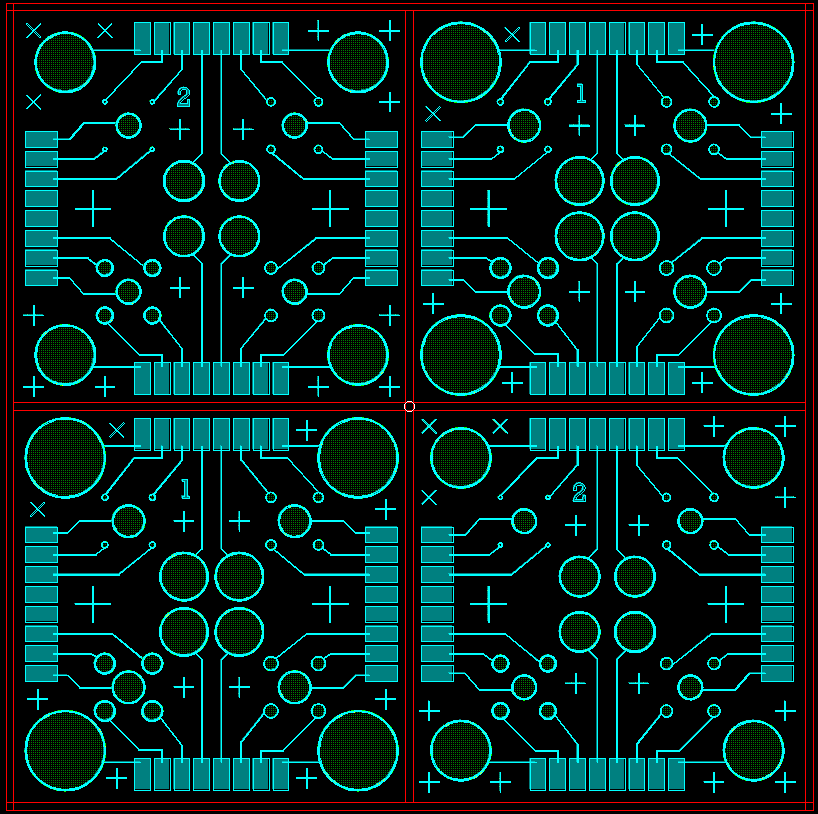
Detector (circles) layout on device chip. These chips are patterned using standard photolithographic techniques. The different detector sizes allow us to probe different characteristics of these devices at room temperature and cryogenic temperatures.
The second detector we are using is a superconducting nano-wire single photon detector (SNSPD) developed and manufactured by Sae Woo Nam's group at the National Institute for Standards and Technology (NIST). These detectors have been shown to be highly efficient with very low dark counts and very high timing resolution [2]. We are currently working to improve the readout electronics of this system by building and testing our own cryogenic readout systems.
[1] - Migdall, Alan, et al. Single-Photon Generation and Detection: Physics and Applications. Vol. 45. Academic Press, 2013.
[2] - Dauler, Eric A., et al. "Review of superconducting nanowire single-photon detector system design options and demonstrated performance." Opt. Eng 53.8 (2014): 081907.
Current implementations of ion-trap quanutm computing are hindered by the need for bulky vacuum chambers, large RF helical resonators and non-scalable free space optics which must accomany a single ion trap processing unit. This project aims to rethink ion trap infrastructure from the ground up for scalability, standardization, and ease of use.
The PIVOT project packages a trap under ultra-high vacuum conditions after a surface cleaning procedure, an indium seal maintains the vacuum level, while alleviating the need to keep the external sample chamber UHV clean.
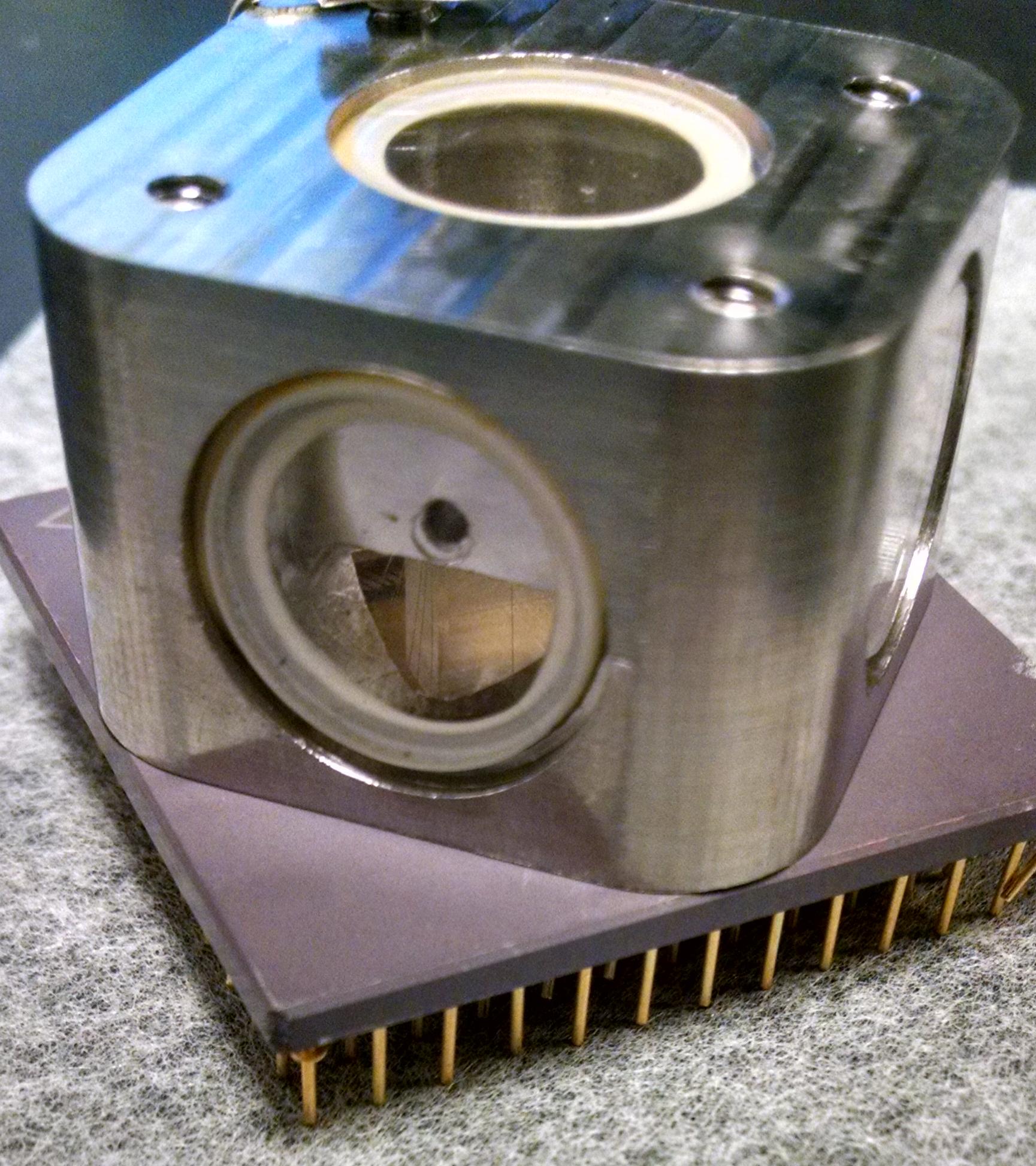
The package is made to work with a closed-cycle Montana Instruments cryostat. A compact RF resonant circuit for cryogenic applications is being produced. The optical system will be mechanically integrated into the cryostat structure while minimizing both optical path length and the degrees of freedom available for tuning. This create a more compact and stable platform for ion trapping. One might think of a future where these ion trap modules are made professionally and sent out to users with verified functional surface electrode ion traps.
Quantum performance simulators can provide practical metrics for the effectiveness of executing theoretical quantum information processing protocols on physical hardware. We made a scheme to simulate the performance of fault tolerant quantum computation by automating the tracking of common fault paths for error propagation through a circuit and quantifying the fidelity of each qubit throughout the computation. Our simulation tool outputs the expected execution time, required number of qubits and the final error rate of running common fault tolerant protocols on a universal hardware, assumed to be a network of qubits with full connectivity. Our technique efficiently estimates the upper bound of error probability and provides a useful performance measure of the error threshold at low error rates where conventional Monte Carlo methods are ineffective. To verify the proposed simulator, we present simulation results comparing the execution of quantum adders which constitute a major part of Shor's algorithm.
The Scalable Platform for agule extended-reach quantum communications (SPARQC) program is an effort to make a Quantum repeater node. A quantum repeater node is a scheme for entanglement distriution over a large geographic area. The best comparison to this technology is a quantum enabled amplifier. The comparison to amplifiers is appropraite not because the quantum signal is made larger (this is forbiden by the no-cloning theorem), but rather becasue it solves the same problem: signal attenuation with distance, that a classical amplifier does.
A quantum repeater network can disseminate entanglement between nearest neighbors and next nearest neighbors. Through a detection scheme the next nearest neighbors can become entangled with each other. If each neighbor is separeted by close to the maximum distance of quantum links then this protocol effectively extends the reach of the quantum information systems to arbitrary sizes.
This project is also interested in creating a Barium Ytterbium Hybrid qubit for sympathetic cooling to be realized. Additionally the possibility of using Barium as a photonic link is explored.
In the realm of quantum mechanics some very interesting phenomena are permitted such as superposition, entanglement, and even quantum teleportation. While the term “quantum teleportation” may sound like something from a sci-fi novel, this is a process can actually be implemented in the lab. Consider Alice and Bob have two quantum systems, such as a trapped ion or a photon, and Alice wants to imprint the state of her system on to Bob’s system. Quantum teleportation describes a mechanism where Alice’s state can be transmitted to Bob’s by using two entangled quantum bits (qubits) as a resource. When Alice and Bob both measure their qubit entanglement enables the quantum state to be moved from Alice to Bob without any knowledge about the state. This is important because any knowledge about the state would collapse the wavefunction and destroy any coherence.
Experimentally, extensive resources are required to teleport an arbitrary quantum state. However, a deterministic (as opposed to probabilistic) protocol called Superdense Quantum Teleportation can send a particular set of quantum states using hyperentangled qubits. These are qubits that are entangled in more than one basis. In our case these are entangled photon pairs from a spontaneous down conversion (SPDC) source. Paul Kwiat’s lab at Illinois has just recently demonstrated a high fidelity of 87% for teleportation [1].
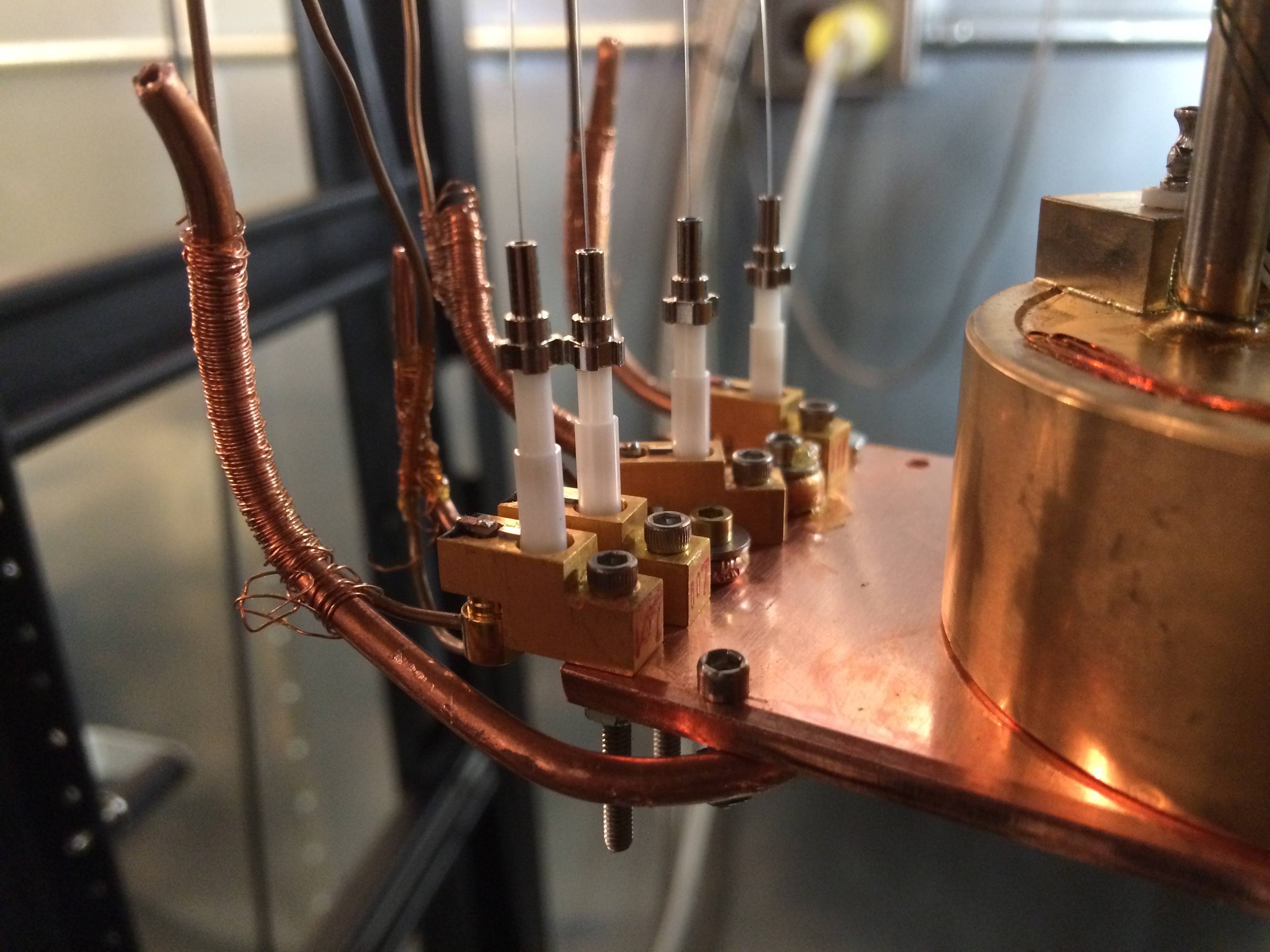
We would like to demonstrate and establish a quantum communication link that allows for superdense teleportation between the International Space Station and Earth. This necessitates the development of efficient and fast single photon detection systems for both nodes of this communication link. At Duke, in conjunction with the Jet Propulsion Laboratory at Caltech, we are testing and developing a detection system based on superconducting nanowire single photon detectors (SNSPDs). These detectors have been shown to be highly efficient with very low dark counts and very high timing resolution [2]. We are currently working to improve the readout electronics of this system by building and testing our own cryogenic readout systems.
[1] - Graham, Trent M., et al. "Superdense teleportation using hyperentangled photons." Nature Communications 6 (2015).
[2] - Dauler, Eric A., et al. "Review of superconducting nanowire single-photon detector system design options and demonstrated performance." Opt. Eng 53.8 (2014): 081907.